G-type main-sequence star SUN
Sun
One star. A whole system of worlds.
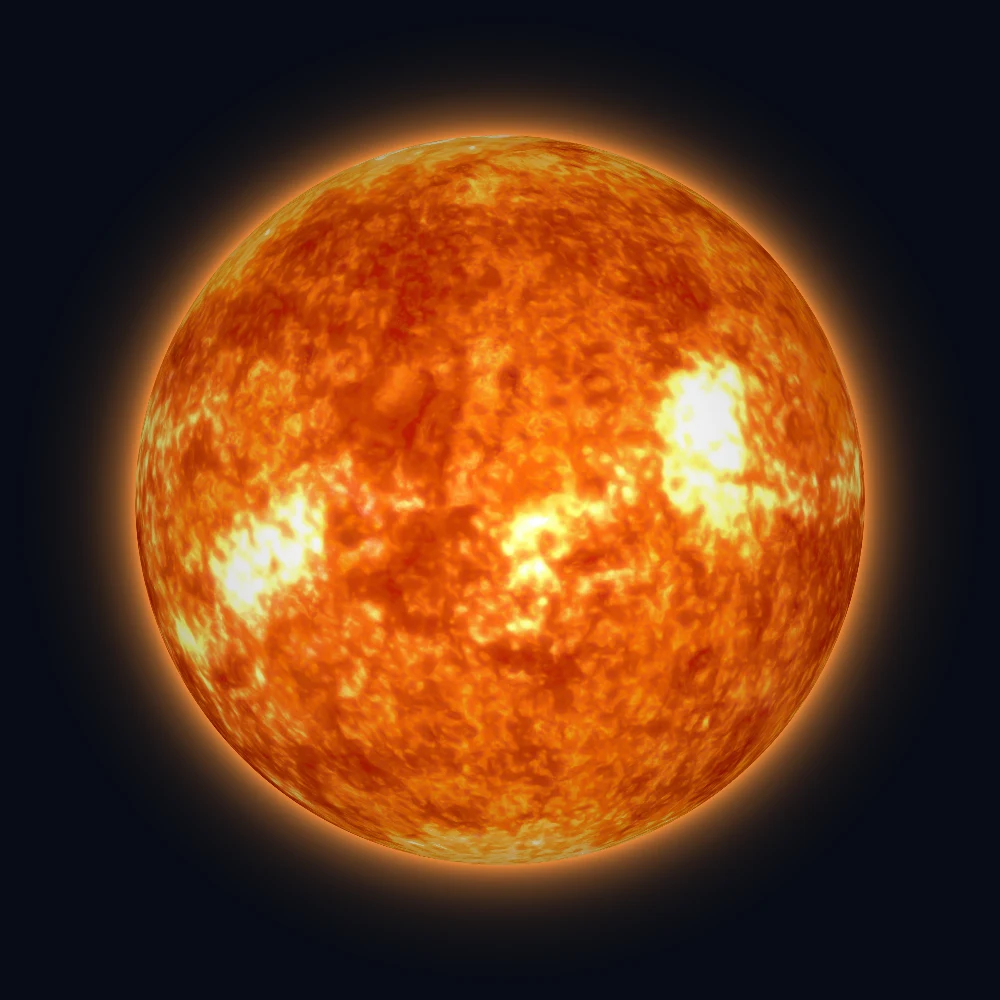
The Sun is a G-type main-sequence star containing about 99.86% of the solar system’s mass. Fusion in its core supplies light and heat, while its gravity keeps the planets in orbit.
- Mean radius
- 696,340 km
- Rotation period
- 25.40 d
01 / Overview
Meet Sun
The Sun holds the planets in orbit and supplies the energy that drives Earth's climate and most life. Its apparently steady disk hides continuous nuclear fusion, a changing surface and a restless atmosphere. Studying our nearest star also reveals the space environment around Earth.
From the core to the visible surface
The Sun consists mainly of hydrogen and helium. Heat and pressure in its core allow hydrogen to fuse, releasing energy that travels through the radiative and convective zones before escaping from the photosphere. This visible surface is not a solid shell: its granular pattern traces hot material rising, cooling and sinking.
How solar magnetism reaches Earth
Sunspots, flares and coronal mass ejections are linked to magnetic activity. The solar wind carries charged particles outward; interactions with Earth's magnetic field and upper atmosphere help produce auroras. Strong solar activity can also disrupt satellites and radio communication, connecting the physics of a star to technology on Earth.
02 / Key data
Core parameters
- Mean radius
- 696,340 km
- Mean Sun distance
- —
- Orbital period
- —
- Rotation period
- 25.40 d
- Natural satellite
- —
- Main composition
- Hydrogen & helium
- Photosphere temperature (approx.)
- 5,500 °C
- Core temperature (approx.)
- 15,000,000 °C
- Energy source
- Hydrogen fusion
Data and calculation notes
Radii are mean values; orbital data describe each world’s scale and motion.
03 / Further reading
A closer look
Structure and energy10
The Sun is a star powered by nuclear fusion in its core.
The solar core fuses hydrogen into helium, converting a little mass into energy.
The Sun contains about 99.8% of the Solar System's total mass.
The Sun's visible surface is about 5,500°C.
The Sun's core is about 15 million°C.
The visible solar layer is the photosphere, not solid ground.
The Sun is made mainly of hydrogen and helium.
A prism spreads sunlight into a spectrum; spectral lines reveal its chemical composition.
Granules on the photosphere are linked to convection near the surface.
Inside the Sun, radiative and convective zones transport energy outward in different ways.
Solar activity9
The Sun's outer atmosphere, the corona, can reach millions of degrees Celsius.
During a total solar eclipse, the bright photosphere is hidden and the corona becomes visible.
Sunspots are cooler, strongly magnetic regions, but remain extremely hot.
Solar activity follows a roughly 11-year cycle whose length varies.
The Sun is not rigid; equatorial regions usually rotate faster than polar regions.
The solar wind consists of charged particles flowing outward from the Sun.
Solar flares rapidly release energy and can affect radio communication on Earth.
Coronal mass ejections send large amounts of plasma and magnetic field into space.
Auroras arise when charged particles interact with the upper atmosphere; solar activity influences them.
Evolution and the Solar System11
Sunlight takes about 8 minutes 20 seconds to reach Earth on average.
The Sun is about 4.6 billion years old.
The Sun will eventually expand into a red giant, billions of years from now.
The Sun is not massive enough to end its life as a core-collapse supernova.
The Sun's remaining dense core will eventually become a white dwarf.
The Sun moves too, orbiting the Milky Way's center with the Solar System.
The Sun takes a little over 200 million years to orbit the Milky Way once.
The Sun's influence extends far beyond Neptune; its solar wind creates the vast heliosphere.
Solar System bodies orbit their common center of mass; planets make the Sun wobble slightly too.
The Sun looks nearly white in space; Earth's atmosphere changes the colors we see.
Solar gravity keeps the eight planets and many small bodies in orbits around the Sun.
04 / Sources
Trusted sources
NASA Science — SunJPL — Orbital dataImage credits
Images reproject and light existing textures; they are not live observations.
Surface texture:Solar System Scope · License · Rendered by ORBIT
Share this profile
Keep the texture credits and license when reusing an image. Image credits