Terrestrial planet MARS
Mars
A red desert with a watery past
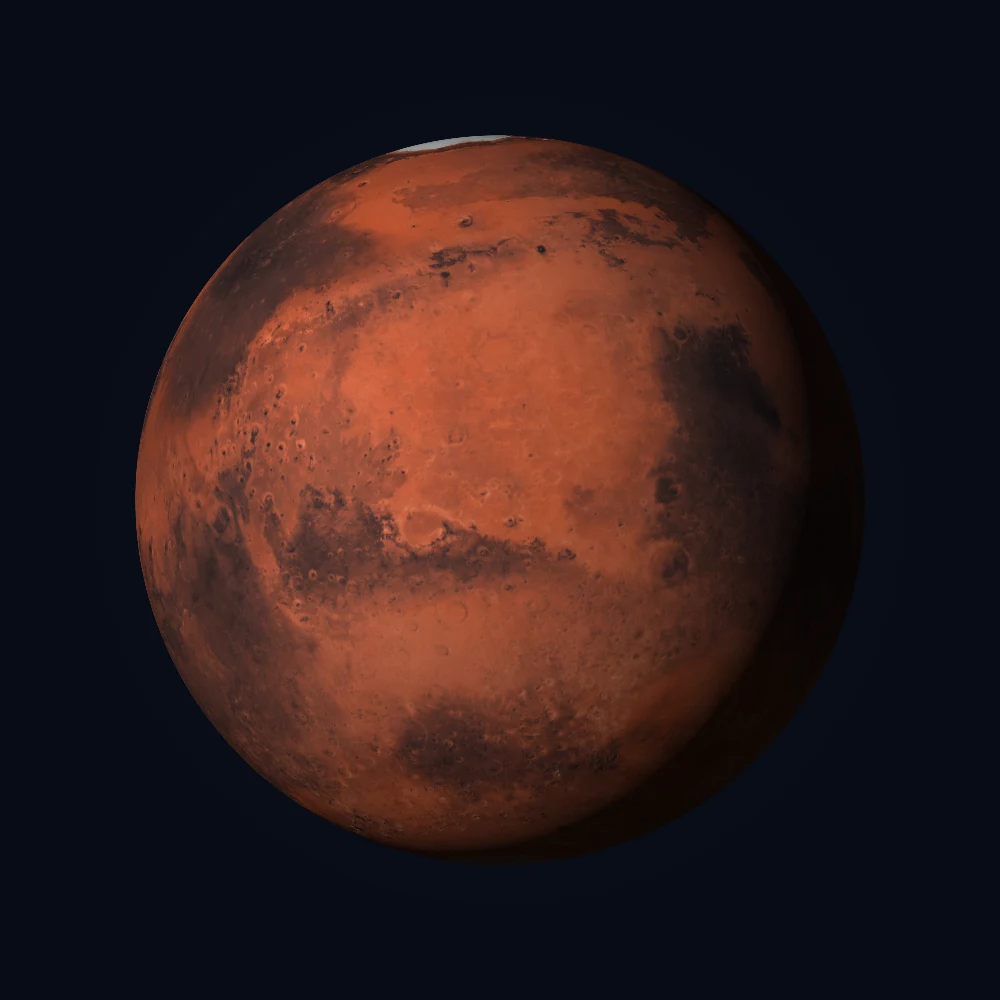
Iron oxides give the surface its red color. Giant volcanoes, canyons, and polar caps mark this world, while ancient channels record a wetter past.
- Mean radius
- 3,389.5 km
- Mean Sun distance
- 1.524 AU
- Orbital period
- 686.98 d
01 / Overview
Meet Mars
Mars is red because iron-bearing minerals have oxidized. Today's planet is cold, dry and thin-aired, yet valleys, deltas and other landforms preserve evidence of ancient water. An Earth-like day alongside immense volcanoes and canyons makes our neighboring world both familiar and strikingly different.
Reading an ancient climate in the terrain
Dry channels and deltas point to water conditions different from those of modern Mars. Water ice persists at the poles and underground, but the thin atmosphere makes long-lived surface liquid water difficult. Studying terrain and rocks helps reconstruct this changing environment; evidence of water alone is not evidence of life.
Giant landforms and long seasons
Olympus Mons and Valles Marineris reveal the scale of Martian geology. Mars has a tilted rotation axis and seasons, but its longer orbit generally makes those seasons longer than Earth's. Polar caps change through the year, and dust storms can spread across the planet, altering the face of this seemingly still desert.
02 / Key data
Core parameters
- Mean radius
- 3,389.5 km
- Mean Sun distance
- 1.524 AU
- Orbital period
- 686.98 d
- Rotation period
- 1.03 d
- Natural satellite
- 2 · Phobos, Deimos
- Mass (approx.)
- 6.417 × 10²³ kg
- Mean density
- 3.934 g/cm³
- Equatorial gravity
- 3.71 m/s²
- Escape velocity
- 5.03 km/s
- Diameter (from mean radius)
- 6,779 km
- Orbital eccentricity (approx.)
- 0.0934
- Orbital inclination (approx.)
- 1.85 °
- Rotation direction
- Prograde
Data and calculation notes
Radii are mean values; orbital data describe each world’s scale and motion.
03 / Further reading
A closer look
Surface and water8
Mars's red color comes from oxidized iron minerals, much like rust.
Olympus Mons is an enormous shield volcano, far taller than Earth's highest mountains.
Valles Marineris is a vast canyon system extending thousands of kilometers.
Mars has a very thin atmosphere, mostly carbon dioxide.
Mars's polar caps contain water ice and seasonally changing carbon dioxide ice.
Dry valleys and deltas show that liquid water once flowed on ancient Mars.
Martian dust storms sometimes grow to cover nearly the entire planet.
Mars has two small moons: Phobos and Deimos.
Time and orbit14
A Martian day lasts about 24 hours 39 minutes, close to an Earth day.
Mars has seasons, generally longer than Earth's because its year is longer.
At its mean distance, sunlight takes about 12.7 minutes to reach Mars.
A year on Mars lasts about 1.88 Earth years.
Mars has a sidereal rotation period of about 24.6 hours.
Using this site's orbital elements, Mars is about 1.38 AU from the Sun at perihelion.
Using this site's orbital elements, Mars is about 1.67 AU from the Sun at aphelion.
A circular-orbit estimate at the mean distance gives Mars a speed around 24.1 km/s; its actual speed varies along the orbit.
The Sun lies at a focus of an elliptical orbit, not at its geometric center.
Along a given elliptical orbit, a body generally moves faster near the Sun.
An eccentricity of zero is a circle; as it approaches one, the ellipse becomes more elongated.
A sidereal day uses distant stars as a reference; a solar day measures the Sun's return to the same meridian.
Orbital inclination needs a reference plane; planetary orbits often use Earth's orbital plane.
The Solar System is not a static flat diagram: planets move above and below the reference plane.
Scale and observation8
Mars has a mean diameter of about 6,779 km, twice its mean radius.
Assuming a sphere, Mars has an equatorial circumference of about 21,297 km.
Mars has a mean radius about 0.53 times Earth's.
From its mean radius, Mars has about 0.151 times Earth's volume.
Axial tilt changes how sunlight reaches different latitudes and is a key cause of seasons.
The visible light of planets seen with the naked eye is mainly reflected sunlight.
Mass and radius together determine surface gravity; a larger body need not have stronger gravity.
A telescope shows a body as it was when its light left; greater distance generally means a longer light-travel time.
04 / Sources
Trusted sources
NASA Science — MarsJPL — Orbital dataImage credits
Images reproject and light existing textures; they are not live observations.
Surface texture:Solar System Scope · License · Rendered by ORBIT
Share this profile
Keep the texture credits and license when reusing an image. Image credits