Natural satellite Deimos
Deimos
A small companion beyond Phobos
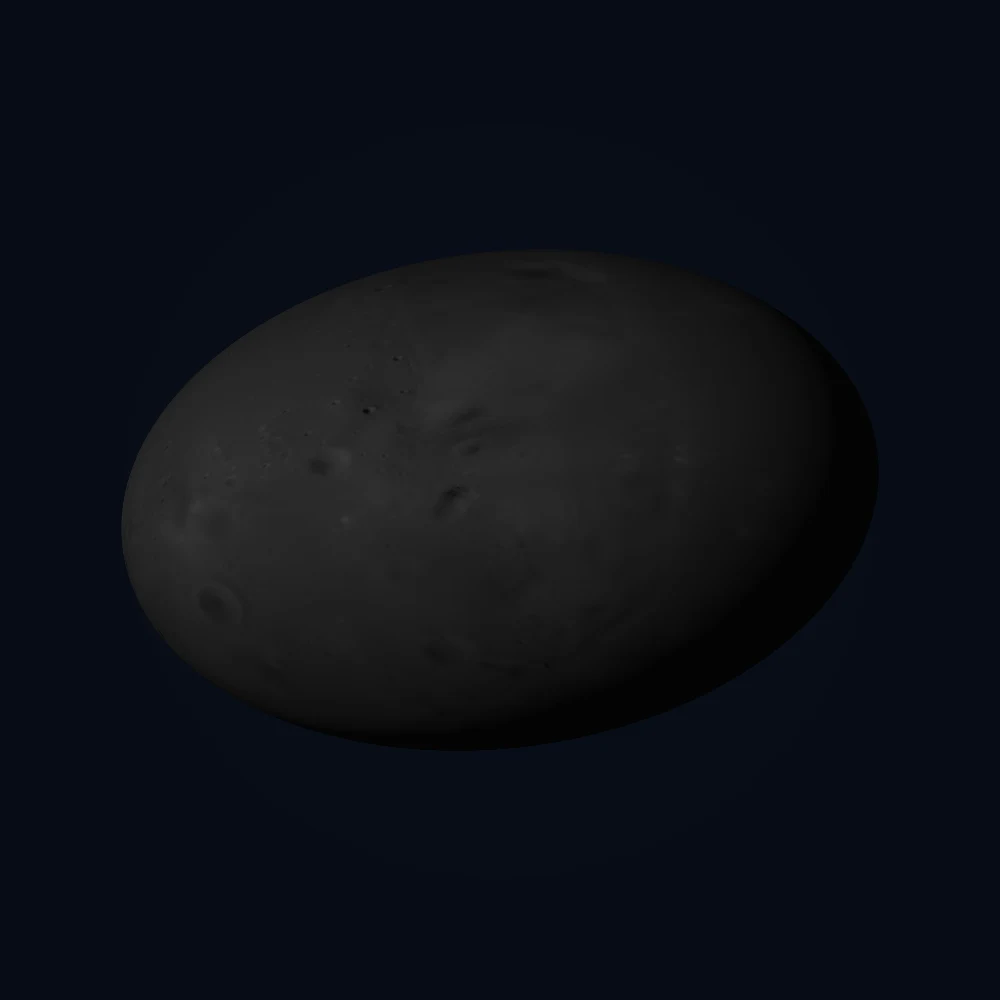
It orbits outside Phobos, taking about 30 hours per circuit. Loose surface material gives it a smoother appearance than Phobos.
- Mean radius
- 6.2 km
- Mean diameter
- 12.4 km
- Orbital semimajor axis
- 23,457 km
01 / Overview
Meet Deimos
Deimos is smaller than Phobos and follows a more distant orbit. It too is irregular, but loose surface material covers some of its terrain and gives it a smoother appearance. Comparing the two moons reveals how surface debris, impacts and orbital setting shape small bodies.
02 / Key data
Core parameters
- Mean radius
- 6.2 km
- Mean diameter
- 12.4 km
- Orbital semimajor axis
- 23,457 km
- Orbital period
- 1.26244 d
- Parent planet
- Mars
Data and calculation notes
Radii are mean values; orbital data describe each world’s scale and motion.
03 / Further reading
A closer look
What makes this world distinctive5
Deimos is smaller than Phobos and farther from Mars.
Deimos was discovered in 1877.
Loose material on Deimos partly masks its impact features.
Deimos is a small, irregularly shaped moon.
Deimos orbits Mars in about 30 hours, slightly longer than a Martian day.
Gravity and the interior14
A natural satellite forms naturally and orbits a larger body; an artificial satellite is built by people.
Tidal locking matches rotation to orbital motion; it does not mean no rotation.
A moon's orbit need not lie in the same plane as its planet's orbit around the Sun.
Differences in gravity across a moon can deform it through tides.
Repeated tidal deformation can turn orbital energy into internal heat.
Orbital resonance means periods near simple integer ratios, allowing repeated pulls between moons to build up.
Some moons formed in discs around planets; others may have been captured later.
Small moons are often irregular because their gravity cannot overcome the strength of their materials.
Large moons tend to be rounder because gravity shapes them.
Icy moons may have liquid oceans under their shells; a frozen surface does not mean a fully frozen interior.
Finding water or organic molecules is not the same as finding life.
A planet and moon both orbit their common center of mass; the heavier body's wobble is usually smaller.
Other bodies perturb a moon's orbit; a fixed ellipse is only an approximation.
Moons can be larger than some planets; classification is not based on diameter alone.
Surface and observation11
It orbits outside Phobos, taking about 30 hours per circuit. Loose surface material gives it a smoother appearance than Phobos.
A moon's visible brightness usually comes from reflected sunlight.
Moons have sunlit and dark sides too; the side facing away from the planet is not permanently dark.
Crater counts help estimate surface ages, but resurfacing and the impact environment also matter.
A moon hiding a background star causes an occultation, useful for measuring size or probing an atmosphere.
A moon entering its planet's shadow experiences an eclipse, depending on the orbits' spatial alignment.
Tiny changes in a spacecraft's speed can reveal a moon's mass and gravity field.
Composition, grain size, and lighting all affect surface color; enhanced-color images differ from naked-eye views.
The day–night boundary is the terminator; long shadows nearby bring out terrain.
Surfaces with little or no atmosphere lack strong weather erosion and preserve old impact scars more easily.
A moon's observed phases come from changing angles between the Sun, moon, and observer.
04 / Sources
Trusted sources
NASA Science — DeimosJPL — Orbital dataImage credits
Images reproject and light existing textures; they are not live observations.
Surface texture:Phil Stooke / NASA PDS · License · Rendered by ORBIT
Share this profile
Keep the texture credits and license when reusing an image. Image credits