Gas giant JUPITER
Jupiter
Beneath the storms, a planetary giant
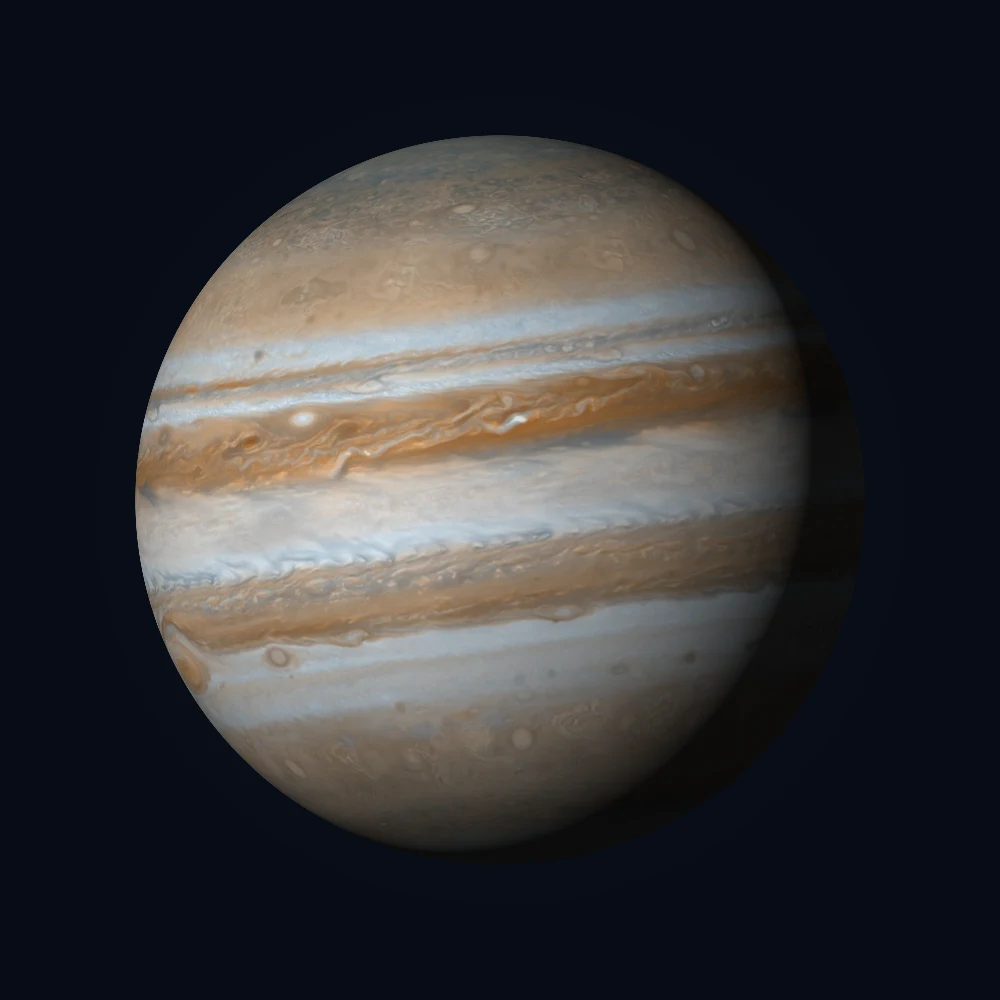
The largest planet, made mostly of hydrogen and helium. Huge storms churn between cloud bands, and a powerful magnetic field surrounds its rich moon system.
- Mean radius
- 69,911 km
- Mean Sun distance
- 5.203 AU
- Orbital period
- 11.9 yr
01 / Overview
Meet Jupiter
Jupiter's bands and Great Red Spot reveal only the visible outer atmosphere. There is no solid ground like Earth's; pressure and temperature increase inward. Rapid rotation, a powerful magnetic field and a rich satellite system make Jupiter a laboratory for studying giant planets and the evolution of their moons.
What creates the cloud bands
Jupiter rotates in less than ten hours, and east-west atmospheric flows organize clouds into contrasting bands. The Great Red Spot is a long-lived storm, not a permanent marking. Understanding what lies beneath requires gravity and magnetic measurements as well as photographs of the cloud tops.
Four large moons, four different worlds
Io's volcanoes, Europa's icy shell, Ganymede's magnetic field and Callisto's ancient cratered terrain show how different neighboring moons can be. Orbital resonances and tidal heating connect gravitational interactions to internal activity, helping explain why worlds in the same system follow different paths.
02 / Key data
Core parameters
- Mean radius
- 69,911 km
- Mean Sun distance
- 5.203 AU
- Orbital period
- 11.9 yr
- Rotation period
- 0.41 d
- Natural satellite
- Includes 4 Galilean moons
- Mass (approx.)
- 1.898 × 10²⁷ kg
- Mean density
- 1.326 g/cm³
- Equatorial gravity
- 24.79 m/s²
- Escape velocity
- 60.20 km/s
- Diameter (from mean radius)
- 139,822 km
- Orbital eccentricity (approx.)
- 0.048386
- Orbital inclination (approx.)
- 1.3 °
- Rotation direction
- Prograde
Data and calculation notes
Radii are mean values; orbital data describe each world’s scale and motion.
03 / Further reading
A closer look
Atmosphere and interior7
Jupiter is more than twice as massive as all the other planets combined.
Jupiter has no solid ground like Earth; pressure keeps rising deeper inside.
Jupiter's Great Red Spot is a huge, long-lived storm.
Jupiter rotates in under ten hours, the fastest spin among the eight planets.
Jupiter's light and dark bands arise from atmospheric circulation and differing clouds.
Jupiter's powerful magnetic field creates a vast magnetosphere and intense radiation.
Juno measures gravity and magnetism to study Jupiter's interior beneath its clouds.
Moons and exploration3
Jupiter has rings, though much less conspicuous than Saturn's.
The four large moons Galileo observed in 1610 showed that not everything orbits Earth.
Fragments of Comet Shoemaker–Levy 9 hit Jupiter in 1994, leaving prominent dark scars.
Scale and orbit20
Jupiter has a mean diameter of about 139,822 km, twice its mean radius.
Assuming a sphere, Jupiter has an equatorial circumference of about 439,264 km.
Jupiter has a mean radius about 10.97 times Earth's.
From its mean radius, Jupiter has about 1.32e+3 times Earth's volume.
At its mean distance, sunlight takes about 43.3 minutes to reach Jupiter.
A year on Jupiter lasts about 11.86 Earth years.
Jupiter has a sidereal rotation period of about 9.9 hours.
Using this site's orbital elements, Jupiter is about 4.95 AU from the Sun at perihelion.
Using this site's orbital elements, Jupiter is about 5.45 AU from the Sun at aphelion.
A circular-orbit estimate at the mean distance gives Jupiter a speed around 13.1 km/s; its actual speed varies along the orbit.
The Sun lies at a focus of an elliptical orbit, not at its geometric center.
Along a given elliptical orbit, a body generally moves faster near the Sun.
An eccentricity of zero is a circle; as it approaches one, the ellipse becomes more elongated.
A sidereal day uses distant stars as a reference; a solar day measures the Sun's return to the same meridian.
Axial tilt changes how sunlight reaches different latitudes and is a key cause of seasons.
The visible light of planets seen with the naked eye is mainly reflected sunlight.
Orbital inclination needs a reference plane; planetary orbits often use Earth's orbital plane.
Mass and radius together determine surface gravity; a larger body need not have stronger gravity.
The Solar System is not a static flat diagram: planets move above and below the reference plane.
A telescope shows a body as it was when its light left; greater distance generally means a longer light-travel time.
04 / Sources
Trusted sources
NASA Science — JupiterJPL — Orbital dataImage credits
Images reproject and light existing textures; they are not live observations.
Surface texture:Solar System Scope · License · Rendered by ORBIT
Share this profile
Keep the texture credits and license when reusing an image. Image credits