Gas giant SATURN
Saturn
Countless icy particles, one remarkable ring system
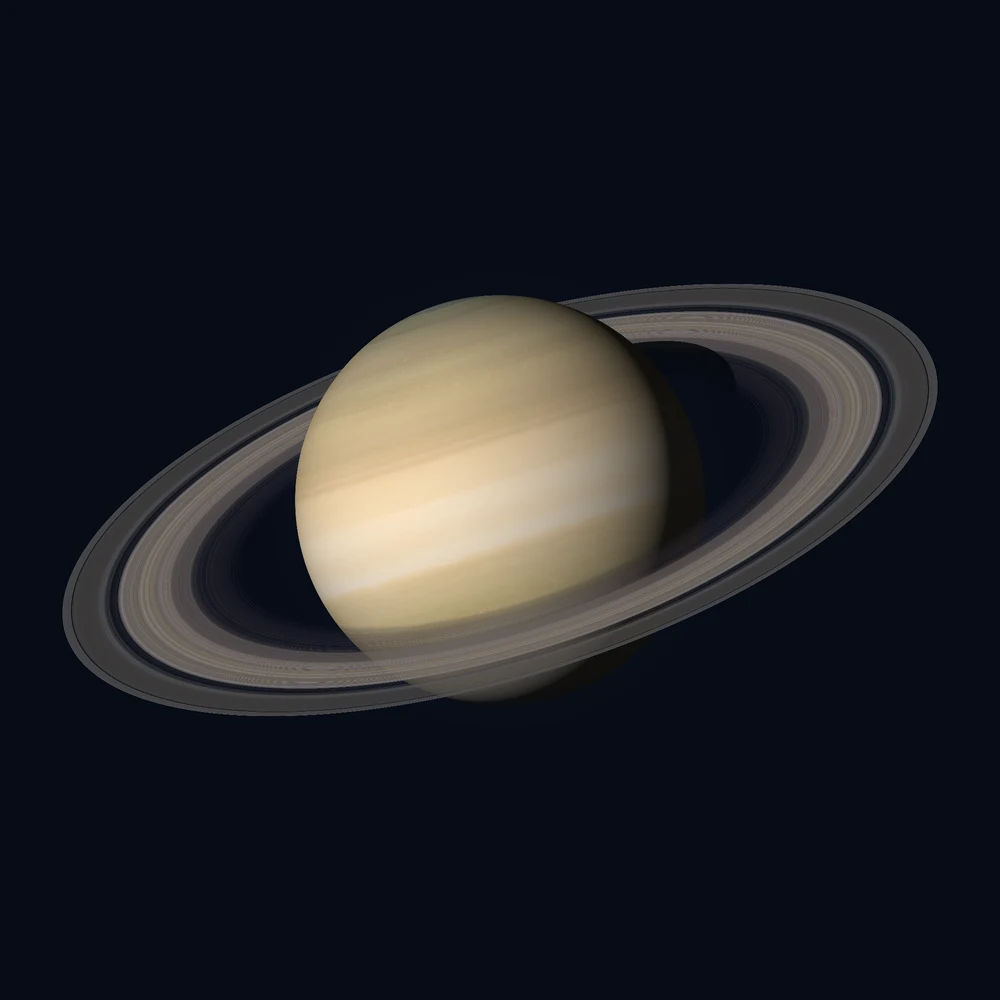
Its bright rings contain countless ice and rock particles. Saturn is a low-density gas giant with a large moon family, including Titan.
- Mean radius
- 58,232 km
- Mean Sun distance
- 9.537 AU
- Orbital period
- 29.5 yr
01 / Overview
Meet Saturn
Saturn's rings are not solid hoops. Countless particles follow individual orbits, interacting with moons to form intricate bands and gaps. Saturn itself is a rapidly spinning gas giant whose clouds, seasons and satellite worlds reward attention just as much as its famous rings.
Broad rings, remarkably little thickness
Saturn's rings consist mainly of water-ice particles spread over a vast area but with little vertical thickness. Features such as the Cassini Division reflect interactions among particles and moons, rather than simple empty spaces. As Saturn orbits, the rings' apparent tilt changes and they can look extremely thin when nearly edge-on.
From methane lakes to hidden oceans
Cassini-Huygens revealed Saturn's moons as complex worlds. Titan has a dense atmosphere and lakes of liquid hydrocarbons, while Enceladus ejects water vapor and ice grains from southern fractures. Liquids, internal heat and geological activity are therefore not confined to Earth-like planets.
02 / Key data
Core parameters
- Mean radius
- 58,232 km
- Mean Sun distance
- 9.537 AU
- Orbital period
- 29.5 yr
- Rotation period
- 0.44 d
- Natural satellite
- Includes Titan and Enceladus
- Mass (approx.)
- 5.683 × 10²⁶ kg
- Mean density
- 0.687 g/cm³
- Equatorial gravity
- 10.44 m/s²
- Escape velocity
- 36.09 km/s
- Diameter (from mean radius)
- 116,464 km
- Orbital eccentricity (approx.)
- 0.053862
- Orbital inclination (approx.)
- 2.49 °
- Rotation direction
- Prograde
Data and calculation notes
Radii are mean values; orbital data describe each world’s scale and motion.
03 / Further reading
A closer look
Planetary rings5
Saturn's rings consist of countless independently orbiting particles, mostly water ice.
Saturn's rings span a huge width but are very thin vertically.
The Cassini Division is a prominent gap in Saturn's rings, but it is not completely empty.
Ice grains from Enceladus continually replenish Saturn's faint E ring.
Saturn has seasons; the apparent tilt of its rings from Earth changes along its orbit.
Atmosphere and exploration5
Saturn's average density is below water's, though no real bathtub could hold it.
Saturn's north pole has a famous hexagonal atmospheric flow pattern.
Saturn's rapid rotation produces a pronounced equatorial bulge.
Cassini entered Saturn orbit in 2004 and studied the system until 2017.
Huygens descended through Titan's thick atmosphere and landed in 2005.
Scale and orbit20
Saturn has a mean diameter of about 116,464 km, twice its mean radius.
Assuming a sphere, Saturn has an equatorial circumference of about 365,882 km.
Saturn has a mean radius about 9.14 times Earth's.
From its mean radius, Saturn has about 764 times Earth's volume.
At its mean distance, sunlight takes about 79.3 minutes to reach Saturn.
A year on Saturn lasts about 29.46 Earth years.
Saturn has a sidereal rotation period of about 10.7 hours.
Using this site's orbital elements, Saturn is about 9.02 AU from the Sun at perihelion.
Using this site's orbital elements, Saturn is about 10.05 AU from the Sun at aphelion.
A circular-orbit estimate at the mean distance gives Saturn a speed around 9.6 km/s; its actual speed varies along the orbit.
The Sun lies at a focus of an elliptical orbit, not at its geometric center.
Along a given elliptical orbit, a body generally moves faster near the Sun.
An eccentricity of zero is a circle; as it approaches one, the ellipse becomes more elongated.
A sidereal day uses distant stars as a reference; a solar day measures the Sun's return to the same meridian.
Axial tilt changes how sunlight reaches different latitudes and is a key cause of seasons.
The visible light of planets seen with the naked eye is mainly reflected sunlight.
Orbital inclination needs a reference plane; planetary orbits often use Earth's orbital plane.
Mass and radius together determine surface gravity; a larger body need not have stronger gravity.
The Solar System is not a static flat diagram: planets move above and below the reference plane.
A telescope shows a body as it was when its light left; greater distance generally means a longer light-travel time.
04 / Sources
Trusted sources
NASA Science — SaturnJPL — Orbital dataImage credits
Images reproject and light existing textures; they are not live observations.
Surface texture:Solar System Scope · License · Rendered by ORBIT
Share this profile
Keep the texture credits and license when reusing an image. Image credits