Ice giant URANUS
Uranus
An ice giant tipped onto its side
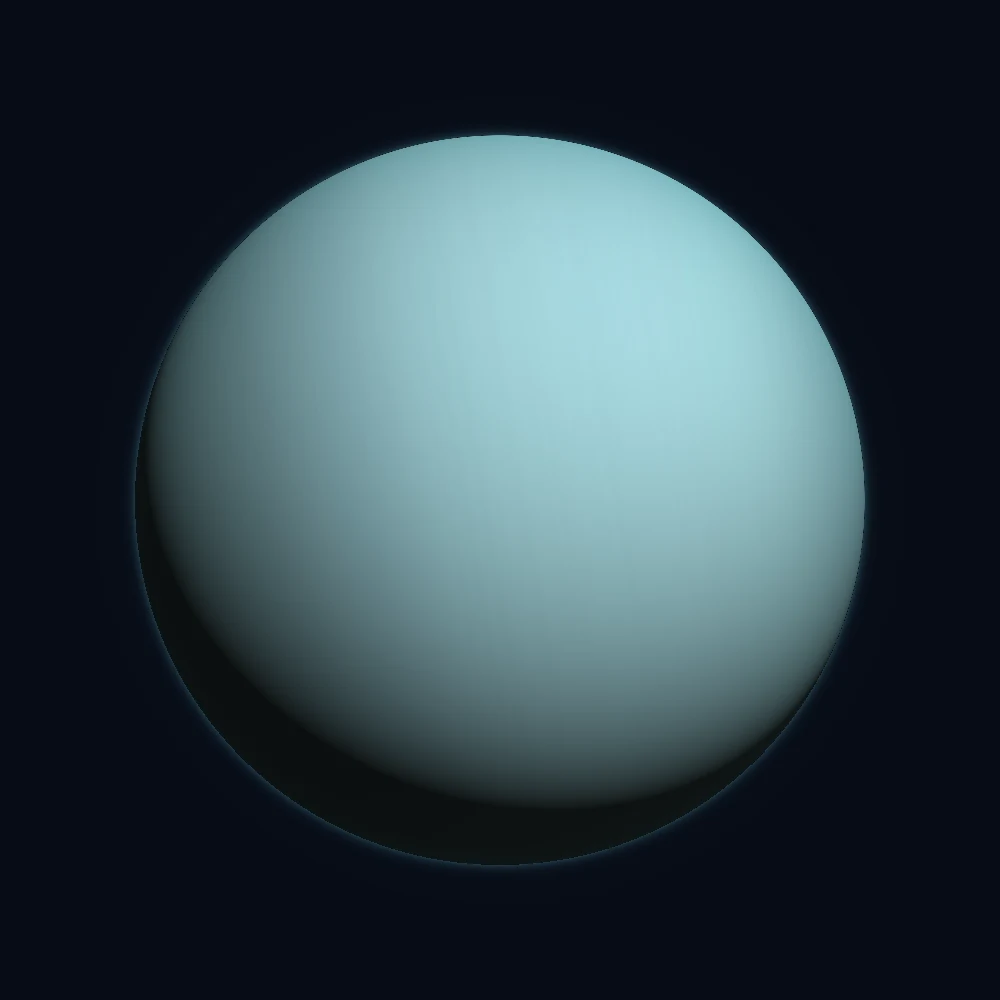
Methane absorbs red light, giving its atmosphere a blue-green appearance. Its extreme axial tilt makes it orbit the Sun almost on its side.
- Mean radius
- 25,362 km
- Mean Sun distance
- 19.191 AU
- Orbital period
- 84 yr
01 / Overview
Meet Uranus
Uranus's blue-green clouds hide an extreme axial tilt and unusual seasons. Along with Neptune, it belongs to the ice giants, whose interiors differ from those of Jupiter and Saturn. Faint rings and icy moons surround a distant world about which much remains unknown.
An almost sideways rotation axis
An axial tilt of about 98 degrees gives Uranus's poles prolonged periods of sunlight and darkness during its long orbit. Earth-like assumptions about seasons do not apply directly. Rotation, orbital orientation and the direction of sunlight must be considered together to understand this extreme seasonal geometry.
An ice giant is not a solid ball of ice
In planetary science, 'ices' refers to materials such as water, ammonia and methane, not necessarily ordinary frozen solids throughout a high-pressure interior. Methane's absorption of red light contributes to the blue-green appearance. Voyager 2 images and distant observations provide much of our knowledge of the planet and its moons.
02 / Key data
Core parameters
- Mean radius
- 25,362 km
- Mean Sun distance
- 19.191 AU
- Orbital period
- 84 yr
- Rotation period
- 0.72 d
- Natural satellite
- Includes Titania and Oberon
- Mass (approx.)
- 8.681 × 10²⁵ kg
- Mean density
- 1.270 g/cm³
- Equatorial gravity
- 8.87 m/s²
- Escape velocity
- 21.38 km/s
- Diameter (from mean radius)
- 50,724 km
- Orbital eccentricity (approx.)
- 0.047257
- Orbital inclination (approx.)
- 0.77 °
- Rotation direction
- Retrograde
Data and calculation notes
Radii are mean values; orbital data describe each world’s scale and motion.
03 / Further reading
A closer look
Rotation and seasons3
Uranus's axis tilts about 98°, making it appear to roll around the Sun on its side.
Uranus's poles can experience decades of continuous sunlight or darkness.
Uranus's magnetic axis is highly tilted to its spin axis, and the field is offset from the planet's center.
Atmosphere and exploration7
Methane in Uranus's atmosphere absorbs red light, giving it a blue-green appearance.
Uranus is an ice giant, with relatively large amounts of water, ammonia, and methane inside.
William Herschel discovered Uranus in 1781 and initially thought it was a comet.
Uranus has faint rings, some first detected when they occulted a star.
Voyager 2 flew past Uranus in 1986, imaging the planet and its moons.
Uranus's major moons are named after characters in works by Shakespeare and Alexander Pope.
Ice in ice giant refers to classes of material, not an entire planet made of solid ice.
Scale and orbit20
Uranus has a mean diameter of about 50,724 km, twice its mean radius.
Assuming a sphere, Uranus has an equatorial circumference of about 159,354 km.
Uranus has a mean radius about 3.98 times Earth's.
From its mean radius, Uranus has about 63.1 times Earth's volume.
At its mean distance, sunlight takes about 159.6 minutes to reach Uranus.
A year on Uranus lasts about 84.02 Earth years.
Uranus has a sidereal rotation period of about 17.2 hours.
Using this site's orbital elements, Uranus is about 18.28 AU from the Sun at perihelion.
Using this site's orbital elements, Uranus is about 20.10 AU from the Sun at aphelion.
A circular-orbit estimate at the mean distance gives Uranus a speed around 6.8 km/s; its actual speed varies along the orbit.
The Sun lies at a focus of an elliptical orbit, not at its geometric center.
Along a given elliptical orbit, a body generally moves faster near the Sun.
An eccentricity of zero is a circle; as it approaches one, the ellipse becomes more elongated.
A sidereal day uses distant stars as a reference; a solar day measures the Sun's return to the same meridian.
Axial tilt changes how sunlight reaches different latitudes and is a key cause of seasons.
The visible light of planets seen with the naked eye is mainly reflected sunlight.
Orbital inclination needs a reference plane; planetary orbits often use Earth's orbital plane.
Mass and radius together determine surface gravity; a larger body need not have stronger gravity.
The Solar System is not a static flat diagram: planets move above and below the reference plane.
A telescope shows a body as it was when its light left; greater distance generally means a longer light-travel time.
04 / Sources
Trusted sources
NASA Science — UranusJPL — Orbital dataImage credits
Images reproject and light existing textures; they are not live observations.
Surface texture:Solar System Scope · License · Rendered by ORBIT
Share this profile
Keep the texture credits and license when reusing an image. Image credits