Ice giant NEPTUNE
Neptune
A distant blue world with fierce winds
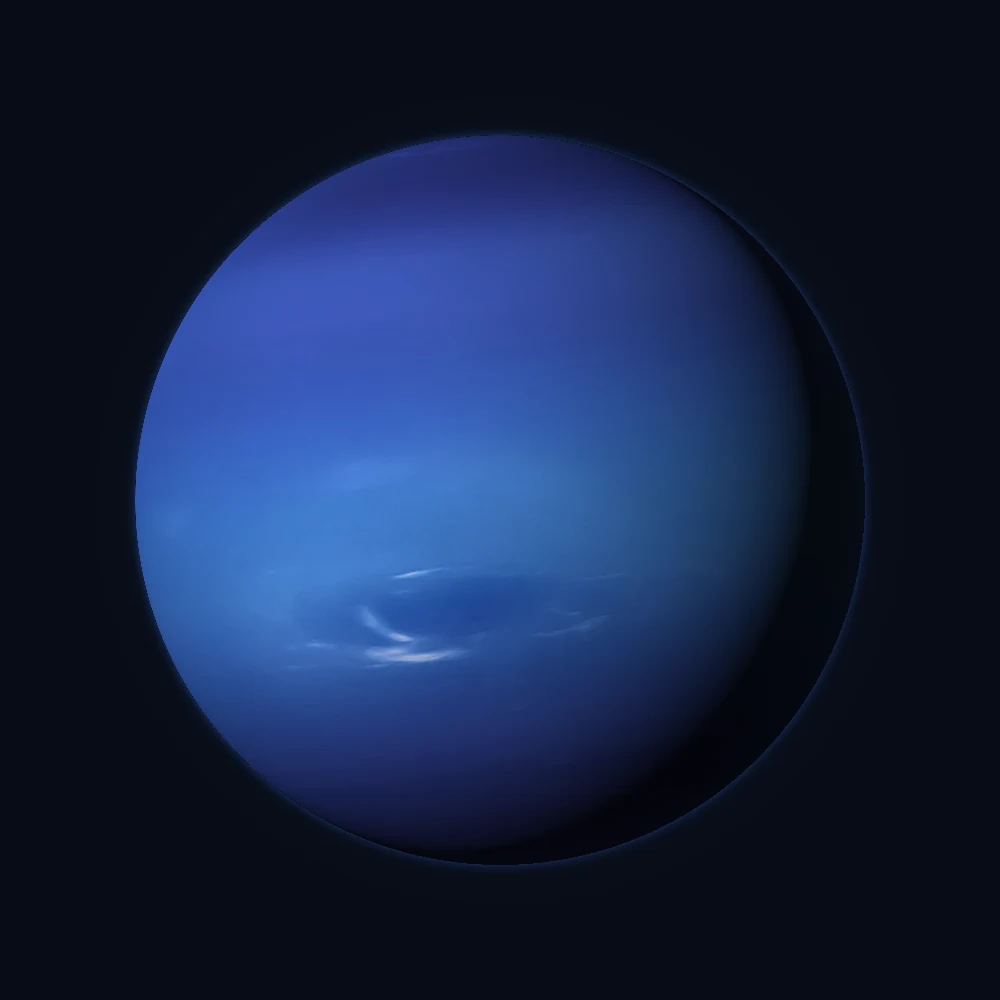
The farthest of the eight planets. Strong storms fill its cold atmosphere. Familiar deep-blue images are enhanced; its natural color is paler.
- Mean radius
- 24,622 km
- Mean Sun distance
- 30.069 AU
- Orbital period
- 164.8 yr
01 / Overview
Meet Neptune
Neptune receives little sunlight, yet its atmosphere is far from quiet. Strong winds and changing storms shape its clouds, while internal heat escapes outward. Mathematical prediction helped lead to its discovery, and the backward-orbiting moon Triton hints at a history involving capture.
An active atmosphere under weak sunlight
Large dark storms can appear in Neptune's clouds, but these spots evolve rather than mark fixed terrain. Methane affects its visible color, and image processing can also influence its appearance. Unlike Earth, Neptune has no solid outer surface to stand on; conditions become increasingly pressurized inward.
A planet found with mathematics
Unexpected deviations in Uranus's motion led researchers to infer another planet's gravitational pull. Calculations helped observers locate Neptune in 1846. Its orbit takes about 165 Earth years, so it completed its first orbit since discovery only in 2011—a reminder of the outer Solar System's scale.
02 / Key data
Core parameters
- Mean radius
- 24,622 km
- Mean Sun distance
- 30.069 AU
- Orbital period
- 164.8 yr
- Rotation period
- 0.67 d
- Natural satellite
- Includes Triton
- Mass (approx.)
- 1.024 × 10²⁶ kg
- Mean density
- 1.638 g/cm³
- Equatorial gravity
- 11.15 m/s²
- Escape velocity
- 23.56 km/s
- Diameter (from mean radius)
- 49,244 km
- Orbital eccentricity (approx.)
- 0.00859
- Orbital inclination (approx.)
- 1.77 °
- Rotation direction
- Prograde
Data and calculation notes
Radii are mean values; orbital data describe each world’s scale and motion.
03 / Further reading
A closer look
Atmosphere and interior5
Neptune's high-altitude winds can exceed the speed of sound on Earth.
Methane in Neptune's atmosphere absorbs red light, affecting its visible color.
Neptune's Great Dark Spot was an atmospheric storm; such storms form, change, and disappear.
Neptune emits more energy than it absorbs from the Sun.
Neptune has no solid outer surface to stand on like Earth's ground.
Discovery and moons5
Neptune was discovered in 1846 with the help of mathematical predictions.
Voyager 2's 1989 Neptune flyby was a landmark close-up exploration.
Neptune has faint rings, with unevenly distributed material forming arcs in some of them.
Triton orbits opposite to Neptune's rotation.
Neptune completed its first orbit since discovery in 2011.
Scale and orbit20
Neptune has a mean diameter of about 49,244 km, twice its mean radius.
Assuming a sphere, Neptune has an equatorial circumference of about 154,705 km.
Neptune has a mean radius about 3.86 times Earth's.
From its mean radius, Neptune has about 57.7 times Earth's volume.
At its mean distance, sunlight takes about 250.1 minutes to reach Neptune.
A year on Neptune lasts about 164.77 Earth years.
Neptune has a sidereal rotation period of about 16.1 hours.
Using this site's orbital elements, Neptune is about 29.81 AU from the Sun at perihelion.
Using this site's orbital elements, Neptune is about 30.33 AU from the Sun at aphelion.
A circular-orbit estimate at the mean distance gives Neptune a speed around 5.4 km/s; its actual speed varies along the orbit.
The Sun lies at a focus of an elliptical orbit, not at its geometric center.
Along a given elliptical orbit, a body generally moves faster near the Sun.
An eccentricity of zero is a circle; as it approaches one, the ellipse becomes more elongated.
A sidereal day uses distant stars as a reference; a solar day measures the Sun's return to the same meridian.
Axial tilt changes how sunlight reaches different latitudes and is a key cause of seasons.
The visible light of planets seen with the naked eye is mainly reflected sunlight.
Orbital inclination needs a reference plane; planetary orbits often use Earth's orbital plane.
Mass and radius together determine surface gravity; a larger body need not have stronger gravity.
The Solar System is not a static flat diagram: planets move above and below the reference plane.
A telescope shows a body as it was when its light left; greater distance generally means a longer light-travel time.
04 / Sources
Trusted sources
NASA Science — NeptuneJPL — Orbital dataImage credits
Images reproject and light existing textures; they are not live observations.
Surface texture:Solar System Scope · License · Rendered by ORBIT
Share this profile
Keep the texture credits and license when reusing an image. Image credits