Dwarf planet PLUTO
Pluto
A dwarf planet with a complex, active surface
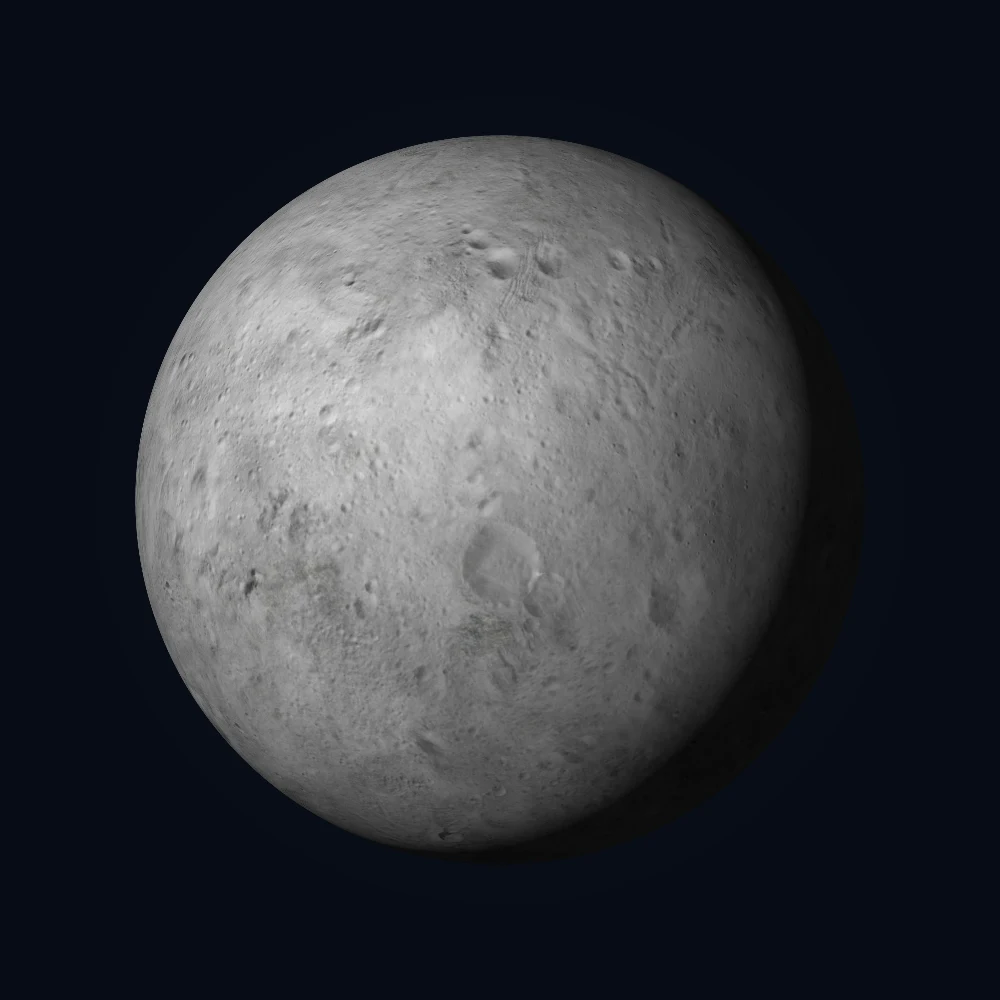
An icy Kuiper Belt world on a notably inclined, elliptical orbit. Classified as a dwarf planet in 2006, it has Charon as its largest moon.
- Mean radius
- 1,188.3 km
- Mean Sun distance
- 39.482 AU
- Orbital period
- 247.9 yr
01 / Overview
Meet Pluto
Pluto is a dwarf planet in the Kuiper Belt. Small and distant does not mean simple: New Horizons revealed nitrogen-ice plains, water-ice mountains and a thin atmosphere. Its partnership with Charon and orbital resonance with Neptune add a distinctive dynamical story to its geology.
Different ices shape different terrain
At Pluto's low temperatures, water ice can form rigid mountains while nitrogen ice moves over geological timescales. Sputnik Planitia shows that this world preserves more than ancient, inactive craters. The contrasting behavior of different ices helps explain its unexpectedly varied terrain.
A shared orbit with Charon
Charon is large relative to Pluto, placing their shared center of mass outside Pluto. Mutual tidal locking keeps roughly the same faces turned toward each other. Pluto sometimes comes closer to the Sun than Neptune, but their resonance controls orbital timing; overlapping paths in a flat diagram do not imply a collision.
02 / Key data
Core parameters
- Mean radius
- 1,188.3 km
- Mean Sun distance
- 39.482 AU
- Orbital period
- 247.9 yr
- Rotation period
- 6.39 d
- Natural satellite
- 5 · Includes Charon
- Mass (approx.)
- 1.302 × 10²² kg
- Mean density
- 1.853 g/cm³
- Equatorial gravity
- 0.62 m/s²
- Escape velocity
- 1.21 km/s
- Diameter (from mean radius)
- 2,376.6 km
- Orbital eccentricity (approx.)
- 0.2488
- Orbital inclination (approx.)
- 17.16 °
- Rotation direction
- Retrograde
Data and calculation notes
Radii are mean values; orbital data describe each world’s scale and motion.
03 / Further reading
A closer look
Surface and atmosphere5
New Horizons flew past Pluto in 2015, returning its first clear close-up images.
Pluto's bright heart-shaped region is called Tombaugh Regio.
Sputnik Planitia is covered in nitrogen ice and shows signs of geological activity.
In Pluto's cold environment, water ice can build mountains like rock.
Pluto's thin atmosphere is mainly nitrogen, with methane and carbon monoxide.
Discovery and orbit5
Clyde Tombaugh discovered Pluto in 1930.
Pluto is a dwarf planet and a major member of the Kuiper Belt.
Pluto and Charon orbit a shared center of mass outside Pluto itself.
Pluto's 3:2 orbital resonance with Neptune helps prevent close encounters.
For part of its orbit, Pluto is closer to the Sun than Neptune.
Scale and observation20
Pluto has a mean diameter of about 2,376.6 km, twice its mean radius.
Assuming a sphere, Pluto has an equatorial circumference of about 7,466 km.
Pluto has a mean radius about 0.19 times Earth's.
From its mean radius, Pluto has about 0.00649 times Earth's volume.
At its mean distance, sunlight takes about 328.4 minutes to reach Pluto.
A year on Pluto lasts about 247.94 Earth years.
Pluto has a sidereal rotation period of about 153.3 hours.
Using this site's orbital elements, Pluto is about 29.66 AU from the Sun at perihelion.
Using this site's orbital elements, Pluto is about 49.31 AU from the Sun at aphelion.
A circular-orbit estimate at the mean distance gives Pluto a speed around 4.7 km/s; its actual speed varies along the orbit.
The Sun lies at a focus of an elliptical orbit, not at its geometric center.
Along a given elliptical orbit, a body generally moves faster near the Sun.
An eccentricity of zero is a circle; as it approaches one, the ellipse becomes more elongated.
A sidereal day uses distant stars as a reference; a solar day measures the Sun's return to the same meridian.
Axial tilt changes how sunlight reaches different latitudes and is a key cause of seasons.
The visible light of planets seen with the naked eye is mainly reflected sunlight.
Orbital inclination needs a reference plane; planetary orbits often use Earth's orbital plane.
Mass and radius together determine surface gravity; a larger body need not have stronger gravity.
The Solar System is not a static flat diagram: planets move above and below the reference plane.
A telescope shows a body as it was when its light left; greater distance generally means a longer light-travel time.
04 / Sources
Trusted sources
NASA Science — PlutoJPL — Orbital dataImage credits
Images reproject and light existing textures; they are not live observations.
Surface texture:cubicApocalypse / CelestiaContent · License · Rendered by ORBIT
Share this profile
Keep the texture credits and license when reusing an image. Image credits