Terrestrial planet EARTH
Earth
Oceans, seasons and life
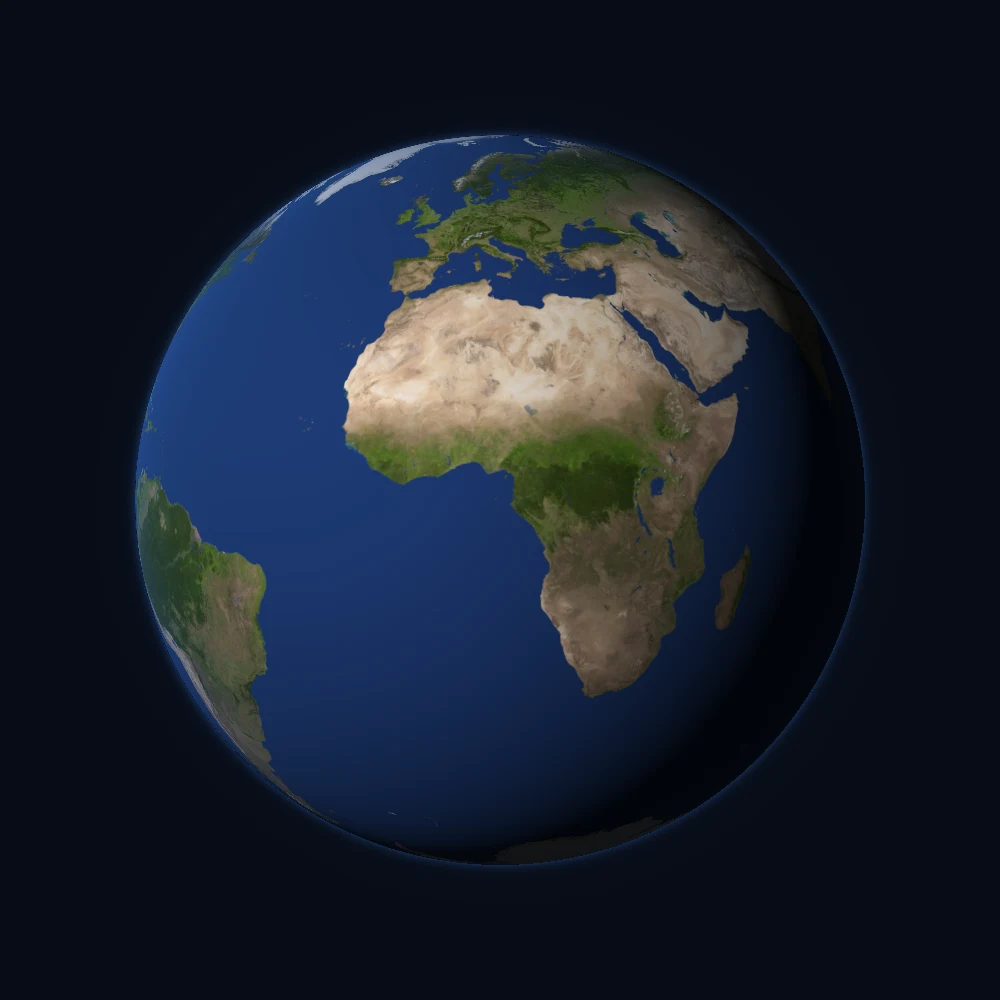
Our blue home and the only world known to host life. Liquid oceans, a protective atmosphere, and a magnetic field help create a life-friendly environment.
- Mean radius
- 6,371 km
- Mean Sun distance
- 1 AU
- Orbital period
- 365.256 d
01 / Overview
Meet Earth
Earth's distinction extends beyond its blue oceans. Air, rock, water and life interact in a continually changing system. Rotation sets the rhythm of day and night, a tilted axis produces the seasons, and the Moon and Sun influence tides. Viewing Earth from space gives familiar daily experiences a planetary context.
Oceans, air and an active surface
Oceans cover about seven tenths of the surface, beneath an atmosphere dominated by nitrogen and oxygen. Internal heat drives geological activity, while interacting plates form mountains, volcanoes and trenches. Motion in the liquid outer core generates the magnetic field. These connected systems sustain life while reshaping its environment over time.
Why the hemispheres have opposite seasons
Earth's tilted axis gives each hemisphere more direct sunlight and longer days at different times of year. Changing distance from the Sun is not the main cause: Earth reaches its closest approach in early January, during northern winter. Rotation and orbital motion also make a sidereal day slightly shorter than a solar day.
02 / Key data
Core parameters
- Mean radius
- 6,371 km
- Mean Sun distance
- 1 AU
- Orbital period
- 365.256 d
- Rotation period
- 1.00 d
- Natural satellite
- 1 · Moon
- Mass (approx.)
- 5.972 × 10²⁴ kg
- Mean density
- 5.513 g/cm³
- Equatorial gravity
- 9.80 m/s²
- Escape velocity
- 11.19 km/s
- Diameter (from mean radius)
- 12,742 km
- Orbital eccentricity (approx.)
- 0.0167
- Orbital inclination (approx.)
- 0 °
- Rotation direction
- Prograde
Data and calculation notes
Radii are mean values; orbital data describe each world’s scale and motion.
03 / Further reading
A closer look
Oceans and life7
Oceans cover about 71% of Earth's surface, helping it look blue from space.
Earth's atmosphere is mainly nitrogen; oxygen makes up about one fifth.
Motion in Earth's liquid outer core generates a magnetic field that affects solar-wind particles.
Earth's outer shell is divided into moving plates; their interactions build mountains and trenches.
The Moon and Sun both drive tides; local coastlines also shape their behavior.
Earth bulges slightly at the equator, so it is not a perfect sphere.
Earth is the only world currently known to host life.
Time and orbit18
Earth's seasons come mainly from its axial tilt, not changes in distance from the Sun.
Earth rotates relative to distant stars in about 23 hours 56 minutes, slightly less than a solar day.
Earth is closest to the Sun around early January, during northern winter.
Earth's mean distance from the Sun is about 149.6 million km; the astronomical unit (AU) was based on this distance.
Using the mean radius and sidereal day, Earth's equator rotates at about 1,670 km/h.
At its mean distance, sunlight takes about 8.3 minutes to reach Earth.
Earth's orbit takes about 365.256 days, so calendars need leap rules to stay aligned with seasons; the tropical year used in calendars differs slightly.
Earth has a sidereal rotation period of about 23.9 hours.
Using this site's orbital elements, Earth is about 0.98 AU from the Sun at perihelion.
Using this site's orbital elements, Earth is about 1.02 AU from the Sun at aphelion.
A circular-orbit estimate at the mean distance gives Earth a speed around 29.8 km/s; its actual speed varies along the orbit.
The Sun lies at a focus of an elliptical orbit, not at its geometric center.
Along a given elliptical orbit, a body generally moves faster near the Sun.
An eccentricity of zero is a circle; as it approaches one, the ellipse becomes more elongated.
A sidereal day uses distant stars as a reference; a solar day measures the Sun's return to the same meridian.
Axial tilt changes how sunlight reaches different latitudes and is a key cause of seasons.
Orbital inclination needs a reference plane; planetary orbits often use Earth's orbital plane.
The Solar System is not a static flat diagram: planets move above and below the reference plane.
Scale and observation5
Earth has a mean diameter of about 12,742 km, twice its mean radius.
Assuming a sphere, Earth has an equatorial circumference of about 40,030 km.
The visible light of planets seen with the naked eye is mainly reflected sunlight.
Mass and radius together determine surface gravity; a larger body need not have stronger gravity.
A telescope shows a body as it was when its light left; greater distance generally means a longer light-travel time.
04 / Sources
Trusted sources
NASA Science — EarthJPL — Orbital dataImage credits
Images reproject and light existing textures; they are not live observations.
Surface texture:Solar System Scope · License · Rendered by ORBIT
Share this profile
Keep the texture credits and license when reusing an image. Image credits