Terrestrial planet VENUS
Venus
Earth-sized, with a very different climate
Similar in size to Earth, but wrapped in a thick carbon-dioxide atmosphere. An intense greenhouse effect makes it the planet with the hottest surface.
- Mean radius
- 6,051.8 km
- Mean Sun distance
- 0.723 AU
- Orbital period
- 224.701 d
01 / Overview
Meet Venus
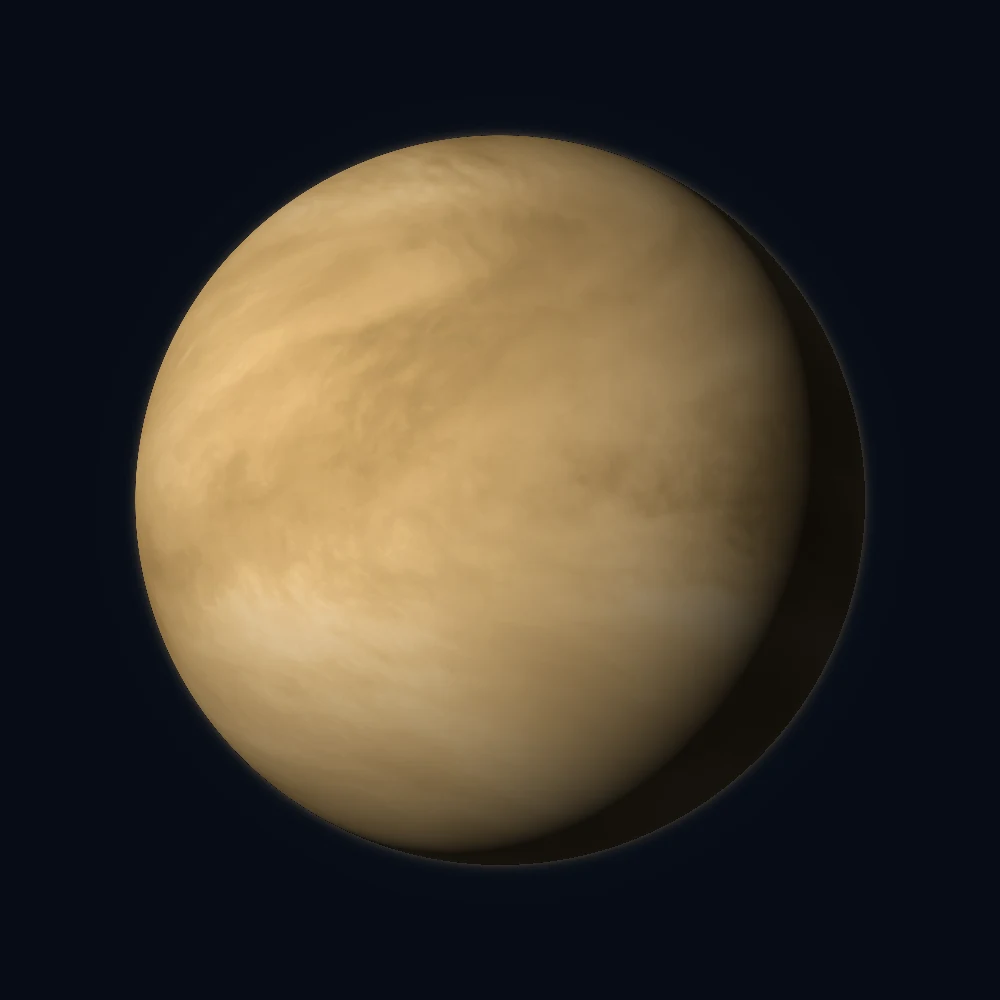
Venus is a rocky planet similar in size to Earth, but its dense carbon dioxide atmosphere overlies an intensely hot surface. Bright clouds make it conspicuous around dawn or dusk while concealing the terrain below. Comparing the two planets reveals how profoundly an atmosphere can shape a world.
The greenhouse world beneath the clouds
Venus's sulfuric-acid clouds do not signal a hospitable climate. Its dense atmosphere traps heat, and surface pressure far exceeds Earth's at sea level. Missions such as Magellan used radar to map the ground hidden from visible light. Cloud portraits and radar maps therefore show different layers of the same planet.
Backward rotation and the evening star
Venus rotates in the opposite direction to most planets, so slowly that its sidereal rotation takes longer than its orbit. Because it orbits inside Earth's path, it stays near the Sun in our sky and is often seen before sunrise or after sunset. Changing geometry also produces its telescopic phases.
02 / Key data
Core parameters
- Mean radius
- 6,051.8 km
- Mean Sun distance
- 0.723 AU
- Orbital period
- 224.701 d
- Rotation period
- 243.03 d
- Natural satellite
- 0
- Mass (approx.)
- 4.867 × 10²⁴ kg
- Mean density
- 5.243 g/cm³
- Equatorial gravity
- 8.87 m/s²
- Escape velocity
- 10.36 km/s
- Diameter (from mean radius)
- 12,103.6 km
- Orbital eccentricity (approx.)
- 0.0068
- Orbital inclination (approx.)
- 3.39 °
- Rotation direction
- Retrograde
Data and calculation notes
Radii are mean values; orbital data describe each world’s scale and motion.
03 / Further reading
A closer look
Atmosphere and surface6
Venus's atmosphere is mostly carbon dioxide; an intense greenhouse effect makes the surface extremely hot.
Surface pressure on Venus is more than 90 times Earth's sea-level pressure.
Venus's thick clouds contain sulfuric acid droplets and hide its terrain.
Venus and Earth have similar diameters but very different surface environments.
Magellan used radar to see through the clouds and map most of Venus's surface.
Venus has no known natural moons.
Time and orbit14
Venus's sidereal rotation takes longer than its orbit around the Sun.
Venus rotates retrograde; through its clouds, the Sun would appear to rise in the west.
At its mean distance, sunlight takes about 6.0 minutes to reach Venus.
A year on Venus lasts about 0.62 Earth years.
Venus has a sidereal rotation period of about 5832.6 hours.
Using this site's orbital elements, Venus is about 0.72 AU from the Sun at perihelion.
Using this site's orbital elements, Venus is about 0.73 AU from the Sun at aphelion.
A circular-orbit estimate at the mean distance gives Venus a speed around 35.0 km/s; its actual speed varies along the orbit.
The Sun lies at a focus of an elliptical orbit, not at its geometric center.
Along a given elliptical orbit, a body generally moves faster near the Sun.
An eccentricity of zero is a circle; as it approaches one, the ellipse becomes more elongated.
A sidereal day uses distant stars as a reference; a solar day measures the Sun's return to the same meridian.
Orbital inclination needs a reference plane; planetary orbits often use Earth's orbital plane.
The Solar System is not a static flat diagram: planets move above and below the reference plane.
Scale and observation10
The morning star and evening star are both Venus, seen before sunrise or after sunset.
Venus shows phases resembling lunar phases through a telescope.
Venus has a mean diameter of about 12,103.6 km, twice its mean radius.
Assuming a sphere, Venus has an equatorial circumference of about 38,025 km.
Venus has a mean radius about 0.95 times Earth's.
From its mean radius, Venus has about 0.857 times Earth's volume.
Axial tilt changes how sunlight reaches different latitudes and is a key cause of seasons.
The visible light of planets seen with the naked eye is mainly reflected sunlight.
Mass and radius together determine surface gravity; a larger body need not have stronger gravity.
A telescope shows a body as it was when its light left; greater distance generally means a longer light-travel time.
04 / Sources
Trusted sources
NASA Science — VenusJPL — Orbital dataImage credits
Images reproject and light existing textures; they are not live observations.
Surface texture:Solar System Scope · License · Rendered by ORBIT
Share this profile
Keep the texture credits and license when reusing an image. Image credits