Terrestrial planet MERCURY
Mercury
Closest to the Sun, but not the hottest
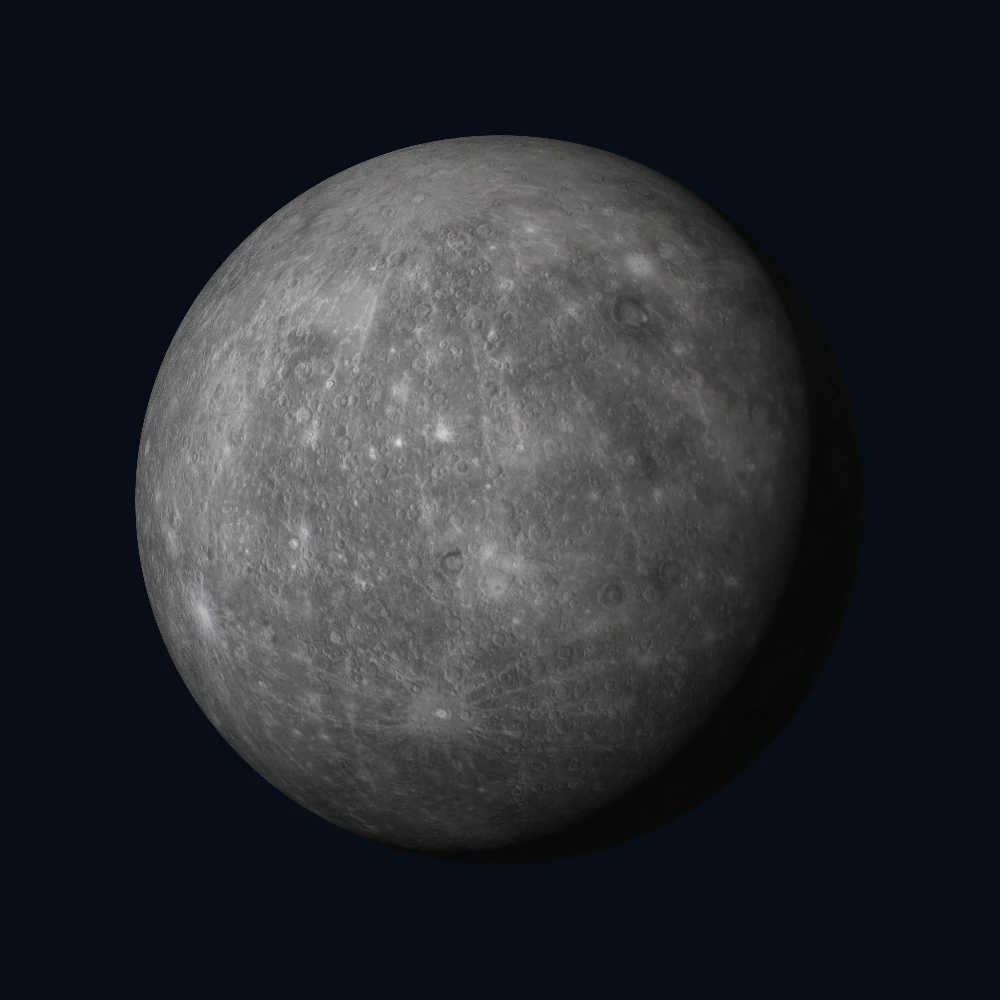
The closest and smallest planet. Its rocky surface is covered in impact craters, and its thin exosphere barely retains heat, leading to extreme day–night temperature swings.
- Mean radius
- 2,439.7 km
- Mean Sun distance
- 0.387 AU
- Orbital period
- 87.969 d
01 / Overview
Meet Mercury
Mercury is a small, dense rocky planet whose surface preserves a long history of impacts. Being close to the Sun does not give it a stable, warm climate: without a thick atmosphere, temperatures differ dramatically between day and night. Slow rotation and a fast orbit create a daily rhythm unlike Earth's.
Why a solar day lasts longer than a year
Mercury turns three times for roughly every two orbits, a 3:2 spin-orbit resonance. Rotation measured against distant stars differs from a solar day, measured from one noon to the next. On Mercury, the latter lasts about 176 Earth days—roughly two Mercurian years.
Craters, scarps and polar ice
Large impact structures such as Caloris record Mercury's early history, while long scarps reveal contraction as its interior cooled. Some crater floors near the poles remain permanently shadowed and can preserve water ice. Extreme heat and ice coexist because sunlight and local terrain vary so strongly.
02 / Key data
Core parameters
- Mean radius
- 2,439.7 km
- Mean Sun distance
- 0.387 AU
- Orbital period
- 87.969 d
- Rotation period
- 58.65 d
- Natural satellite
- 0
- Mass (approx.)
- 3.301 × 10²³ kg
- Mean density
- 5.429 g/cm³
- Equatorial gravity
- 3.70 m/s²
- Escape velocity
- 4.25 km/s
- Diameter (from mean radius)
- 4,879.4 km
- Orbital eccentricity (approx.)
- 0.2056
- Orbital inclination (approx.)
- 7 °
- Rotation direction
- Prograde
Data and calculation notes
Radii are mean values; orbital data describe each world’s scale and motion.
03 / Further reading
A closer look
Surface and environment8
Mercury is closest to the Sun but not the hottest planet; Venus has a much stronger atmospheric greenhouse effect.
Water ice survives in some permanently shadowed craters near Mercury's poles.
Mercury has almost no heat-retaining atmosphere, so day and night temperatures differ greatly.
Mercury's iron core occupies a large fraction of its volume, offering clues to planetary formation.
Long scarps on Mercury record the planet's cooling and contraction.
Caloris is one of Mercury's most prominent large impact basins.
MESSENGER became the first spacecraft to orbit Mercury in 2011.
Mercury has no natural moons or planetary rings.
Time and orbit14
Mercury makes about three rotations for every two orbits, a 3:2 spin–orbit resonance.
Noon to noon on Mercury takes about 176 Earth days, longer than its year.
At its mean distance, sunlight takes about 3.2 minutes to reach Mercury.
A year on Mercury lasts about 0.24 Earth years.
Mercury has a sidereal rotation period of about 1407.5 hours.
Using this site's orbital elements, Mercury is about 0.31 AU from the Sun at perihelion.
Using this site's orbital elements, Mercury is about 0.47 AU from the Sun at aphelion.
A circular-orbit estimate at the mean distance gives Mercury a speed around 47.9 km/s; its actual speed varies along the orbit.
The Sun lies at a focus of an elliptical orbit, not at its geometric center.
Along a given elliptical orbit, a body generally moves faster near the Sun.
An eccentricity of zero is a circle; as it approaches one, the ellipse becomes more elongated.
A sidereal day uses distant stars as a reference; a solar day measures the Sun's return to the same meridian.
Orbital inclination needs a reference plane; planetary orbits often use Earth's orbital plane.
The Solar System is not a static flat diagram: planets move above and below the reference plane.
Scale and observation8
Mercury has a mean diameter of about 4,879.4 km, twice its mean radius.
Assuming a sphere, Mercury has an equatorial circumference of about 15,329 km.
Mercury has a mean radius about 0.38 times Earth's.
From its mean radius, Mercury has about 0.0562 times Earth's volume.
Axial tilt changes how sunlight reaches different latitudes and is a key cause of seasons.
The visible light of planets seen with the naked eye is mainly reflected sunlight.
Mass and radius together determine surface gravity; a larger body need not have stronger gravity.
A telescope shows a body as it was when its light left; greater distance generally means a longer light-travel time.
04 / Sources
Trusted sources
NASA Science — MercuryJPL — Orbital dataImage credits
Images reproject and light existing textures; they are not live observations.
Surface texture:Solar System Scope · License · Rendered by ORBIT
Share this profile
Keep the texture credits and license when reusing an image. Image credits