COMET PROFILE 2P / ENCKE
Encke's Comet
Frequent returns, repeated solar heating
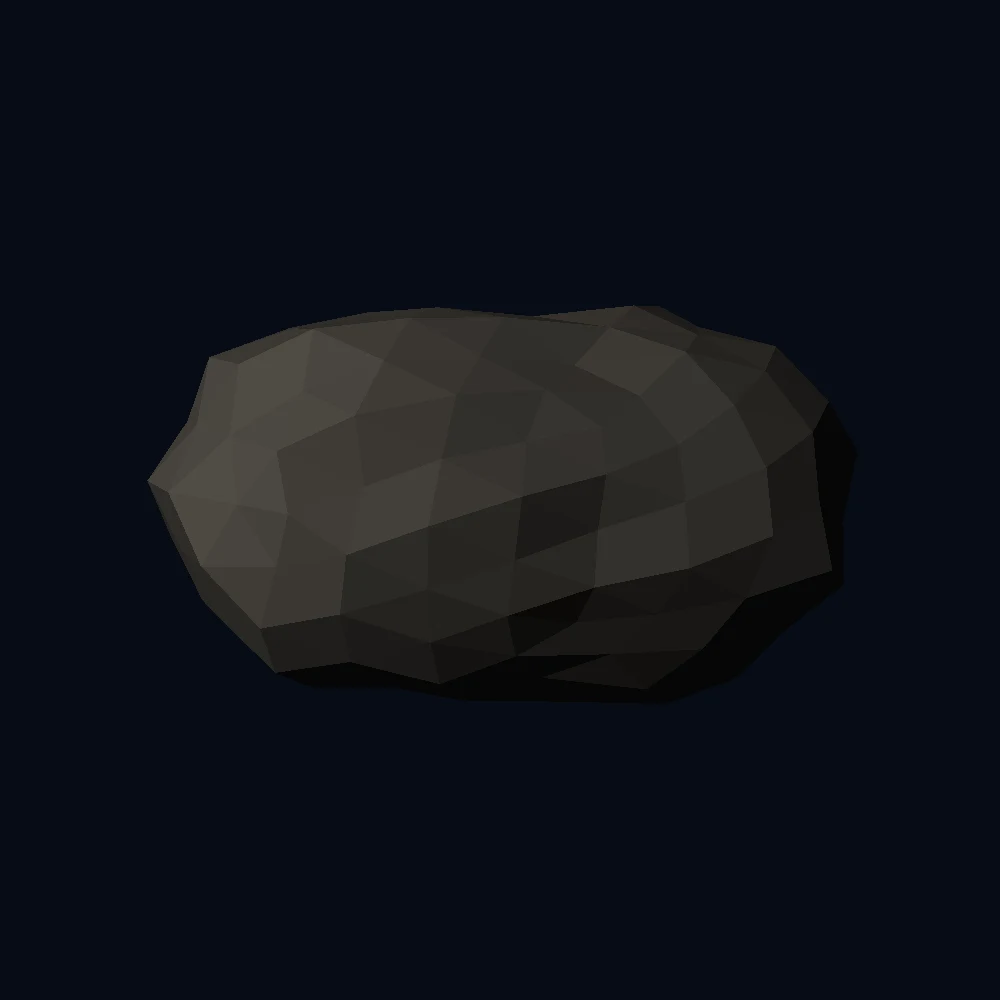
A short-period comet orbiting the Sun in about 3.3 years, with a nucleus roughly 4.8 km across. It returns much more often than Halley's Comet.
- Model orbital period
- 3.3 yr
- Orbital inclination
- 11.4°
- Model perihelion
- 0.34 AU
01 / Overview
Meet Encke's Comet
Encke circles the Sun in about 3.3 years, frequently crossing the inner Solar System. Its elongated orbit brings it from a cooler outer reach to intense perihelion sunlight, repeatedly driving activity and material loss. Debris associated with the Taurid complex links this comet to a wider interplanetary dust environment.
02 / Key data
Core parameters
- Model orbital period
- 3.3 yr
- Orbital inclination
- 11.4°
- Model perihelion
- 0.34 AU
- Model aphelion
- 4.10 AU
Data and calculation notes
Positions use the shared date and JPL orbital elements at a reference epoch. Fixed two-body orbits omit planetary perturbations and outgassing; errors grow away from the epoch. This is not a precise return forecast. Halley and 67P use public observed shape models; Encke and Hale-Bopp use independent approximations constrained by observed sizes. Nucleus surfaces, spin, and tails remain illustrative.
03 / Further reading
A closer look
Discovery and exploration10
Encke's Comet orbits the Sun in only about 3.3 years.
Encke's Comet is named for Johann Encke, who calculated its periodic orbit.
Pierre Méchain first observed Encke's Comet in 1786.
Encke linked observations from different years to confirm they described the same body.
Encke's official designation is 2P, among the earliest numbered periodic comets.
Encke's nucleus is about 4.8 km across, far smaller than a major planet.
Encke's Comet is associated with the Taurid meteoroid complex.
Encke's perihelion lies inside Mercury's orbit; its far end reaches beyond Mars.
Encke's highly eccentric orbit causes large changes in its distance from the Sun.
Frequent returns expose Encke repeatedly to solar heating and material loss.
Coma and tails11
The nucleus is a comet's solid body, made mainly of ice, dust, and rock mixed together.
Near the Sun, cometary ice can sublimate directly to gas and carry dust with it.
The diffuse envelope of gas and dust around the nucleus is the coma.
The solar wind influences the ion tail, directing it roughly away from the Sun.
Dust-tail particles have their own orbits, often producing a curved tail.
A comet's tail can point ahead as it moves away from the Sun; it is not exhaust trailing its motion.
A coma can be many times larger than its nucleus; a photo's bright cloud is not the solid body's size.
Meteor showers can occur when Earth crosses debris left by a comet.
A meteor is light produced when a small particle enters the atmosphere, not a falling star.
Most returning comets still require a telescope to observe.
Comet brightness depends on activity, not just distance from Earth.
Orbit and evolution9
Short-period comets generally have orbital periods under 200 years.
Many long-period comet orbits suggest origins in the distant Oort Cloud.
Comets preserve early Solar System material and help us study planetary formation.
Comets generally move faster at perihelion and slower at aphelion.
Planetary gravity, especially Jupiter's, can change comet orbits and sometimes disrupt their nuclei.
Cometary gas jets exert small reaction forces that precise predictions must include.
Orbital elements refer to an epoch; neglected perturbations can accumulate over time.
P in a comet designation means periodic; C is commonly used for comets that are not short-period.
Dark dust often coats comet nuclei; containing ice does not make their surfaces snow-white.
04 / Sources
Trusted sources
NASA Science — Encke's CometJPL — Orbital dataImage credits
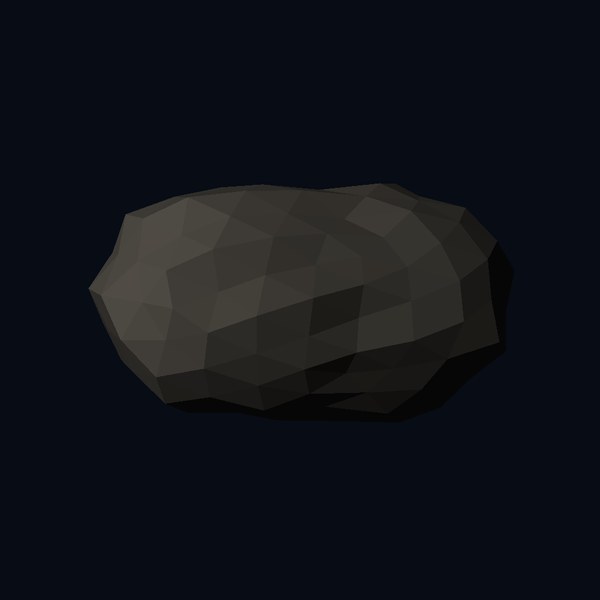
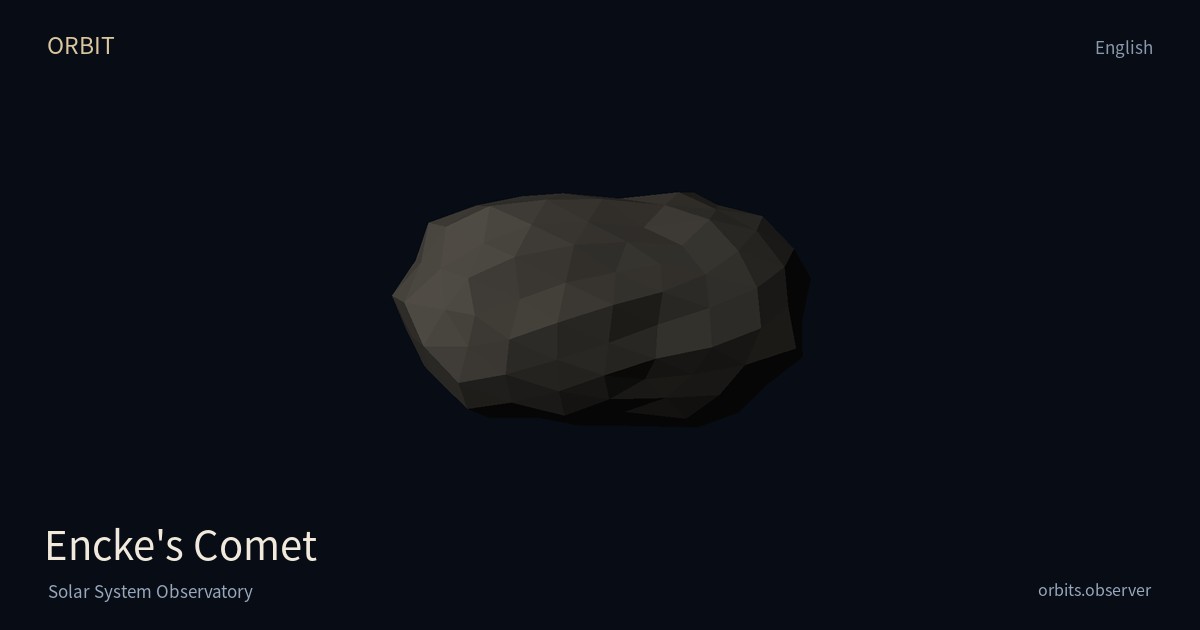
Nucleus shapes use public observed models, or independent approximations constrained by observed sizes when no complete global model is available. No global comet-nucleus albedo maps are available here, so materials, coma, and tails are illustrative rather than current observations.
Surface texture:JPL SBDB physical constraints; no public global nucleus model; ORBIT shape approximation · License · Rendered by ORBIT
Share this profile
Keep the texture credits and license when reusing an image. Image credits