Main-belt asteroid VESTA
Vesta
Main-belt asteroid
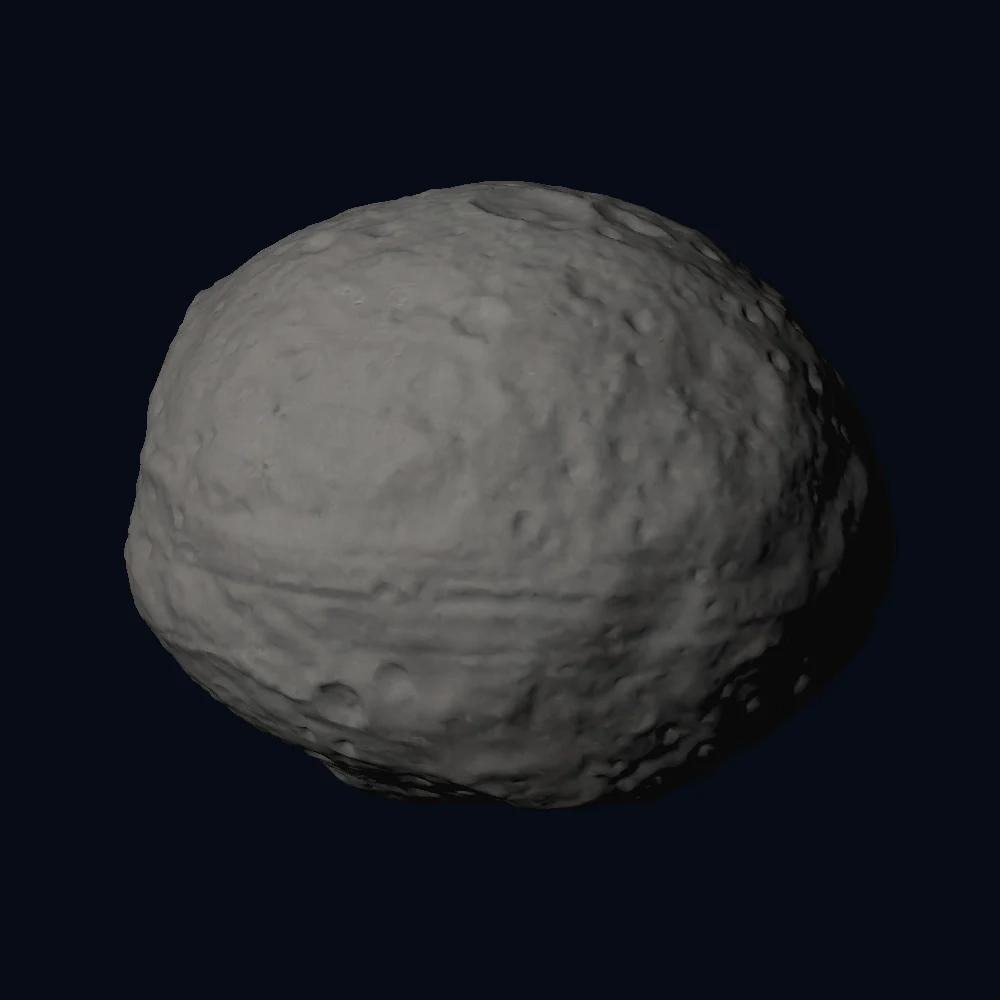
A large main-belt body preserving evidence of early differentiation and volcanism, Vesta was an orbital target of Dawn.
- Equivalent diameter
- 522.77 km
- Orbital semimajor axis
- 2.361 AU
- Model orbital period
- 3.629 yr
01 / Overview
Meet Vesta
Vesta resembles an embryo that never grew into a planet. Its surface and impact basins help trace the early evolution of rocky bodies.
Shape and composition
Giant impact basins in Vesta’s south record violent collisions; some ejected material later reached Earth as meteorites.
Discovery and exploration
Dawn orbited Vesta from 2011 to 2012 before departing for Ceres.
02 / Key data
Core parameters
- Equivalent diameter
- 522.77 km
- Orbital semimajor axis
- 2.361 AU
- Model orbital period
- 3.629 yr
- Rotation period
- 5.342 hours
- Orbital inclination
- 7.144 °
- Orbital eccentricity
- 0.0902
Data and calculation notes
Asteroid positions use epoch-based JPL orbital snapshots and a two-body approximation. Planetary perturbations and thermal radiation effects are omitted; this is not for close-approach or impact prediction. Except for Ceres's observed near-spherical fallback, scene shapes come from mission or PDS models. True sizes use equivalent radii; asteroids do not participate in eclipse calculations.
03 / Further reading
A closer look
Scale and orbit4
Vesta has an equivalent diameter of about 522.77 km: the diameter of a sphere with the same volume.
A year on Vesta lasts about 3.63 Earth years.
Using this site's orbital elements, Vesta is about 2.148 AU from the Sun at perihelion.
Using this site's orbital elements, Vesta is about 2.574 AU from the Sun at aphelion.
Understanding the orbital model2
An orbital snapshot describes motion near its epoch; planetary gravity changes real orbits over time.
Near-Earth asteroid is an orbital classification; it does not mean an impact on Earth is imminent.
04 / Sources
Trusted sources
NASA Science — VestaJPL — Orbital dataImage credits
Published global maps or surface-albedo data are applied only to the matching body. Pallas uses Carry et al.'s published K-band relative-albedo map, which covers about 80% of the surface; unobserved pixels are filled with the mean only to keep the matching model continuous. Psyche uses the per-facet relative-albedo map bundled with DAMIT model 1806. Juno has no downloadable global albedo map, so it keeps its own shape, JPL geometric albedo, and spectral material without borrowing another body's texture.
Surface texture:NASA Dawn / USGS; CelestiaContent · License · Rendered by ORBIT
Share this profile
Keep the texture credits and license when reusing an image. Image credits